
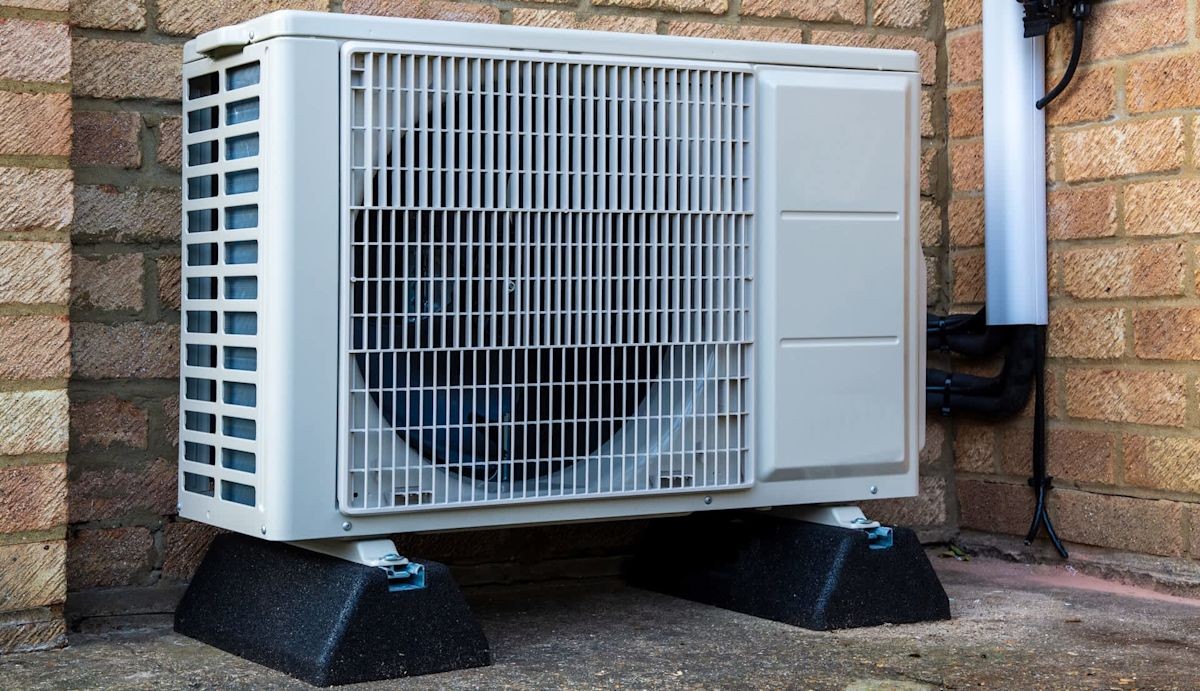
Homeowners in England may need planning permission for heat pumps exceeding a 37-decibel noise limit near a neighbour’s window, according to reporting published by Yahoo News on Nov. 22, 2026.
Most domestic installations qualify for permitted development, meaning they can proceed without a planning application. The exemption still carries technical conditions, and East Devon District Council said residents continue to ask whether their projects comply.
What triggers planning permission?
The main constraint is sound at the receiving property. James Stalker, an Exmouth-based MCS-certified heat pump installer and assessor for the National Association of Professional Inspectors and Testers, said the limit applies one metre outside a neighbour’s door or window to a habitable room.
“Noise is what catches people out. The unit has to come in at 37 decibels or less, one metre outside a neighbour’s door or window to a habitable room,” he said.
Noise is not the only test. East Devon District Council said installations exceeding the noise criteria or measuring more than 1.5 cubic metres, equivalent to 53 cubic feet, can require permission. Listed buildings and some installations in conservation areas also sit outside the exemption.
The practical implication is straightforward: a product marketed as suitable for residential use does not automatically produce a compliant installation. Location, neighbouring windows, building status and the unit’s dimensions all affect the planning assessment.
Boundary rule relaxed in May 2025
Homeowners gained more flexibility in May 2025, when the requirement to leave one metre, or 3.3 feet, between an outdoor unit and the property boundary ended. Stalker said the other conditions remain in force.
That distinction matters for project management. Removing a spatial restriction expands the range of possible sites, but each site still needs a noise assessment. Stalker recommended completing the calculation before committing to a location, using the MCS 020 a method specified in the Devon Live report.
He also advised obtaining the intended flow temperature, radiator details and room-by-room heat loss figures. Those inputs concern system performance rather than planning alone, but collecting them early can reduce the risk of selecting a poorly matched unit or revising the installation after design work has begun.
Installation growth raises administrative stakes
The compliance questions accompany rapid market growth. Annual UK air source heat pump installations reached 53,263 in 2025, compared with fewer than 7,500 in 2018, according to government figures cited by Devon Live.
The South West ranked second for installations through the end of June, accounting for 14% of the UK total of 20,895. The South East led with 18%. Government grants for eligible properties have also supported household interest.
Ministers published the Warm Homes Plan in January, setting a target of 450,000 installations a year by 2030. Reaching that run rate would require a substantial increase from the 2025 figure, placing more weight on installer capacity, consistent advice and predictable local decisions.
For councils, even a small share of uncertain cases can generate a steady advisory workload. For homeowners, an incorrect assumption about permitted development can delay a retrofit or add design costs. For installers, early screening offers a way to identify planning exposure before equipment is ordered.
Why households are seeking written confirmation
East Devon District Council said inquiries include requests for written confirmation that work can proceed without an application. Other residents have asked about projects that may require permission, including heat pumps forming part of larger building works.
A council spokesperson acknowledged that the exceptions can be difficult to interpret.
“Clearly there remain some instances where permission is still needed, such as in the case of listed buildings and in some cases in conservation areas, as well as when they exceed 1.5 cubic metres in size or noise criteria,” the spokesperson said.
“These requirements can be confusing, and we are happy to provide advice,” the spokesperson added.
The process is hardly kacang, or straightforward, for a resident comparing technical thresholds with heritage rules. Written guidance has economic value here: it reduces ambiguity without changing the underlying environmental or neighbourhood protections.
Governance lesson for Southeast Asia
The British use case will not transfer directly to Singapore or most ASEAN markets, where residential heating demand is limited. The administrative lesson does travel. Decarbonisation programmes increasingly depend on thousands of small assets installed at individual properties, rather than a single centralised project.
A Singapore-style approach would treat the rulebook as part of the delivery infrastructure: publish standard calculation methods, give consistent pre-application advice and make approval requirements easy to verify. That supports household investment while preserving enforceable limits on noise and other local effects.
The objective is not deregulation for its own sake. It is a clear division between routine installations that can proceed under defined conditions and exceptional cases that need closer review. England’s experience shows how quickly that boundary becomes commercially relevant once adoption accelerates.
Practical checklist before installation
- Commission an MCS 020 a noise calculation for the proposed site and assess sound one metre outside neighbouring doors or windows to habitable rooms.
- Check whether the outdoor unit exceeds 1.5 cubic metres and confirm the property’s listed or conservation-area status.
- Obtain the intended flow temperature, radiator specifications and heat loss figures for every room before finalising the system design.
- Ask the local council for advice or written confirmation where the permitted development position remains unclear.
Frequently asked questions
Does every heat pump in England need planning permission?
No. Most household installations can proceed under permitted development, provided they meet the applicable noise, size and location conditions. Listed buildings and some conservation-area installations require additional checks.
What changed in May 2025?
The rule requiring one metre between an outdoor heat pump unit and the property boundary was removed. The 37-decibel noise condition and other planning requirements still apply.
When can the unit’s size require approval?
East Devon District Council said an installation larger than 1.5 cubic metres can require permission. Noise above the stated criteria can also take a project outside the exemption.