
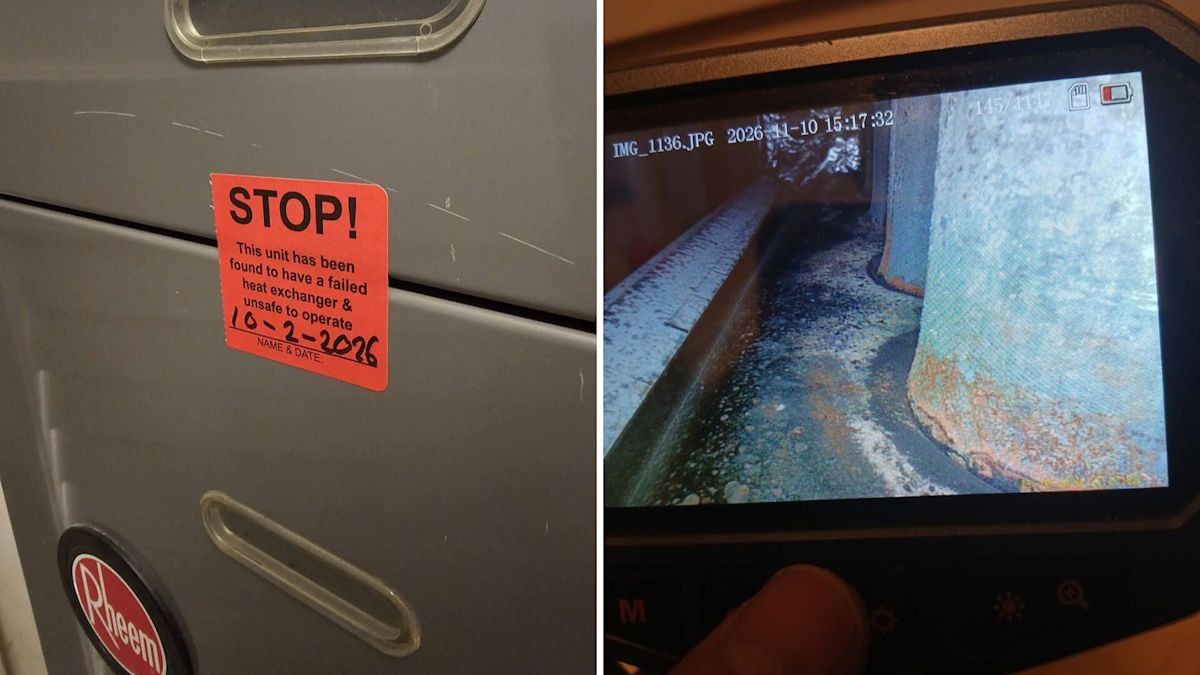
A Chicago-area tenant spent a November weekend on space heaters with outdoor lows in the 20s Fahrenheit after the landlord refused to replace a furnace that two of three technicians had condemned, saying only that it works. The standoff, first reported by Yahoo News on 15 November, has become a case study in how weak enforcement mechanisms leave renters exposed when safety assessments conflict.
The tenant, posting on Reddit's r/HVACAdvice community, laid out the dispute in unusually clean terms: two independent technicians found a failed heat exchanger, while the landlord's own technician cleared the unit for temporary operation. According to Yahoo News, the first technician red-tagged the furnace and shut off its gas after finding heavy rust and scaling, concluding the heat exchanger had failed. A second, independent technician also recommended replacement and left the gas off, citing tubes pulling away from the back plate.
What a red tag actually means
In North American practice, a red tag is a formal condemnation of a gas appliance deemed unsafe to operate. It is not a negotiating position. Yet the landlord's technician, after replacing a pressure switch and running the furnace for roughly 10 minutes, measured zero parts per million of carbon monoxide at the supply vents and approved temporary operation. Crucially, per the Yahoo News account, that technician provided no written report.
The asymmetry is instructive. Two documented findings against one undocumented opinion, and the undocumented opinion prevails because it is the one the asset owner prefers. Commenters on the thread were blunt. One self-identified HVAC service technician with 11 years of experience wrote that systems can run while being absolutely unsafe, and that the landlord was putting money above human life.
He's putting money above human life. CO is nothing to play with.
Why written findings carry the leverage
The Reddit thread converged on a practical playbook: get everything in writing, involve the municipal authority, and never touch the equipment yourself. One commenter advised calling village or city hall, noting that the furnace belongs to the landlord and any tenant interference invites blame-shifting.
That playbook has support beyond the forum. A discussion at HomeOwnersHub recounts a near-identical standoff resolved only when an independent technician issued a report on company letterhead declaring the unit unsafe, with a copy sent to the gas utility. The utility's inspector arrived and pulled the meter, ending the argument. The poster's conclusion is worth noting for any jurisdiction: a red tag from the utility carries legal weight in most places that a contractor's opinion does not.
The lesson for tenants and regulators alike is that informal assessments, however competent, lack enforcement teeth. Documentation plus a statutory actor is what converts a safety finding into an obligation.
A Southeast Asian reading of an American problem
Southeast Asia Insight readers will recognize the structural issue, even if the appliance is foreign. Rental markets across the region, from Jakarta's kos to Hanoi's nhà trọ and Singapore's own HDB flat sublets, face the same principal-agent gap: the party bearing maintenance costs is not the party bearing the safety risk. Carbon monoxide is less common in tropical climates where gas water heaters and unflued heaters are the main exposure points, but the governance question is identical. Who forces compliance when the owner says it works?
Singapore's answer is comparatively robust, and regional policymakers could do worse than study it. The Building Maintenance and Strata Management Act, HDB subletting rules, and the Energy Market Authority's gas licensing regime create multiple statutory hooks. A landlord in Singapore who ignored a documented safety defect would face the Housing Board, the licensed gas worker's reporting obligations, and a tribunal system with low-cost access. The result is not perfect enforcement, but the kiasu instinct of local regulators, always scanning for the next compliance failure, keeps the baseline credible.
The American case shows what happens without that architecture. The tenant's remedies are fragmented: municipal code enforcement, small claims court, or lease remedies that vary by state. Guidance from the Texas State Law Library on landlord-tenant repair disputes illustrates the patchwork, where tenants must navigate notice requirements and repair-and-deduct regimes that differ across jurisdictions. A safety finding that should be dispositive becomes the opening move in a procedural negotiation, conducted in winter, by a tenant holding a space heater.
The economics of deferred maintenance
There is a pro-business case here that landlords and asset managers should internalize. Deferred maintenance is not cost avoidance; it is unpriced liability. A failed heat exchanger is a capital expense measured in thousands of dollars. A carbon monoxide incident is a liability measured in litigation, insurance repricing, and in many jurisdictions, criminal exposure. The landlord demanding two more opinions is buying delay at a price that only makes sense if he believes the tail risk is zero, which the red tag itself refutes.
For institutional landlords and REITs, this is settled doctrine: capital expenditure on life-safety systems is non-discretionary. The informal landlord sector, which houses a large share of renters in both the United States and Southeast Asia, operates without that discipline. That is precisely why regulatory backstops matter, and why the utility's red tag, with its statutory force, is the instrument that finally moves recalcitrant owners.
What happens next
For the Chicago-area tenant, the practical sequence is now clear: obtain written findings from the independent technicians, escalate to municipal code enforcement, and request a gas utility inspection. The HomeOwnersHub precedent suggests the utility route is the decisive one. As winter deepens, the case will test whether documented safety findings can outrank an owner's preference for the status quo.
FAQ
What is a red-tagged furnace?
A red tag is a formal condemnation by a licensed technician or gas utility marking an appliance as unsafe to operate. In the Chicago case, the first technician red-tagged the furnace and shut off its gas after finding a failed heat exchanger.
Can a landlord refuse to replace a red-tagged furnace?
The landlord can refuse, as happened here, but tenants can escalate to municipal code enforcement and the gas utility. A utility-issued red tag carries legal weight in most jurisdictions and typically triggers forced disconnection of the gas supply.
What should a tenant do when safety assessments conflict?
Get every assessment in writing, avoid touching the equipment, and involve the local authority or gas utility. Commenters on the original thread also suggested recovering space-heater electricity costs and consulting an attorney if the landlord continues to refuse.