
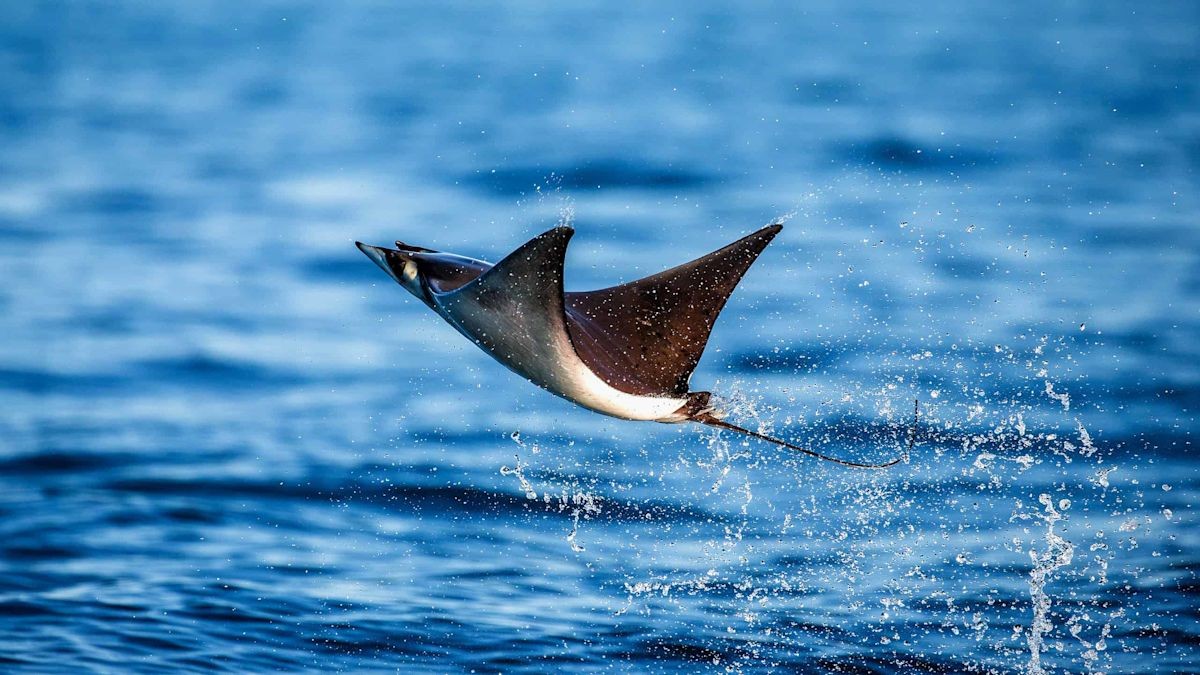
A school of pygmy devil rays appeared off La Jolla Shores in Southern California on Wednesday, Nov. 18, in what researchers believe is the species’ first documented appearance in the United States. Drone operator Chris Hart filmed the rays near The Marine Room, and snorkeler Adena Lamar recorded them underwater the following morning, according to Yahoo News.
The species, Mobula munkiana, normally ranges from the Gulf of California to Peru. Its arrival roughly 620 miles north of published Pacific coast records offers a striking field observation at a time when warm water has extended into Southern California and El Niño is strengthening.
How the pygmy devil rays were identified
Hart, who operates the La Jolla Morning Report, first recorded the school during a Wednesday morning flight. Local diver Nick Meyers, known online as Nautical Nick, identified the animals from that footage.
Meyers, a former biologist who runs an ocean conditions website, initially thought they were spinetail devil rays, which had made their own rare appearance off La Jolla several weeks earlier. Their shorter wingspan pointed to another species. Pygmy devil rays measure 3 to 4 feet across, compared with 6 to 11 feet for spinetail devil rays.
Giuseppe Notarbartolo di Sciara, the marine scientist who described the species in 1987, then contacted Meyers on Instagram. Meyers told the news site La Jolla that the scientist confirmed both the identification and the first US sighting, adding that the video brought him to tears, La Jolla reported.
The animal already had a connection to the neighbourhood. Notarbartolo di Sciara, a former doctoral student at Scripps Institution of Oceanography, named it after his mentor, the late Scripps oceanographer Walter Munk. Ben Frable, senior collection manager of marine vertebrates at Scripps Institution of Oceanography at UC San Diego, told CBS 8 that it was historically called Munk’s devil ray until a North American naming committee removed personal names from common names.
Frable said the physical identification was straightforward.
“They’re a fairly distinctive devil ray species, so it was pretty clear from the get-go,” Frable told CBS 8.
Many other devil and manta rays have curved, sickle-shaped fins. Pygmy devil rays have a wider, triangular wedge shape.
A close encounter in La Jolla
Lamar saw Hart’s footage on Instagram and contacted him. Hart helped guide her to the school, and she swam beside it on Thursday morning.
“I woke up at 8 a.m., and I immediately saw there were crazy rays I’d never seen before in the water, so I ran down as fast as I could to try and record them,” Lamar told CBS 8.
She estimated that the rays were one to two feet wide. Whales can be heard in her video, and Lamar said their calls became “so loud” near the end of the swim.
“It was surreal, honestly,” she told CBS 8. “These animals that you would usually have to travel pretty far to go see, so it was pretty crazy seeing them here in La Jolla.”
Frable said Lamar’s footage shows the rays feeding. They dig into sand to collect small invertebrates, while some also filter plankton from the water.
What is a pygmy devil ray?
The pygmy devil ray is a small ray without a stinger, with triangular pectoral fins that function as wings. A 2021 study in Scientific Reports put adult width at up to about 3.7 feet and estimated newborn width at roughly 14 to 17 inches. The animals often gather in aggregations numbering in the thousands.
Their reproductive rate limits their ability to absorb fishing pressure. The same study notes that manta and devil rays produce one pup per litter on reproductive cycles lasting one to three years. That leaves them exposed to targeted fishing and accidental capture, known as bycatch.
The International Union for Conservation of Nature lists the pygmy devil ray as Vulnerable on its Red List. A school offshore can therefore represent more than a visual spectacle: it is a mobile concentration of animals with slow population replacement.
Why are the rays 620 miles north of their usual range?
Frable told CBS 8 that published records along the Pacific coast generally end around southern Baja California and Bahía Magdalena, approximately 620 miles south of San Diego. A corridor of warm water has stretched up Baja California and into Southern California for a couple of months.
He described the rays as “exploring newly available habitat.” NOAA’s Climate Prediction Center said on Nov. 12 that El Niño continues to strengthen.
Meyers said the species is “really good at traveling long distances,” with groups swimming in V-shaped formations similar to migrating birds. He expects the school to return south when the ocean cools.
Other tropical species have also appeared. Frable said juvenile finescale triggerfish have been common beneath floating kelp offshore. A Moorish idol was posted to iNaturalist from Catalina Island, a species he said had not previously been recorded in California.
A single sighting does not establish a permanent range expansion. It does, however, provide a dated observation that researchers can compare with water temperatures, later sightings and established distribution records.
The regional lesson for marine governance
For Southeast Asia, where coastal livelihoods and fisheries depend on accurate marine information, the most useful element is the observation chain. A drone operator supplied the first record, a diver proposed an identification, a snorkeler documented behaviour, and taxonomic specialists confirmed the result.
That sequence shows the value of connecting public submissions with institutions able to verify them. If warming conditions alter migration routes, ASEAN agencies will need records that distinguish a transient visitor from a sustained biological shift before adjusting conservation or fisheries measures.
Singapore’s governance model offers a relevant benchmark: precise measurement, clear institutional responsibility and timely disclosure. Applied across borders, those habits would make citizen science more useful to regulators without turning every unusual photograph into a premature policy conclusion.
Frequently asked questions
Was this the first pygmy devil ray sighting in the US?
Researchers believe so. Frable said it is believed to be the first documentation of the species in the United States, and Notarbartolo di Sciara also confirmed the first US sighting to Meyers.
Are pygmy devil rays dangerous to swimmers?
The species has no stinger. Lamar swam alongside the school and filmed the animals feeding without reporting any aggressive behaviour.
Are the rays still off La Jolla?
CBS 8 launched a drone several times on Friday and did not find them. Meyers believes they will travel south to their typical range once the water cools.