
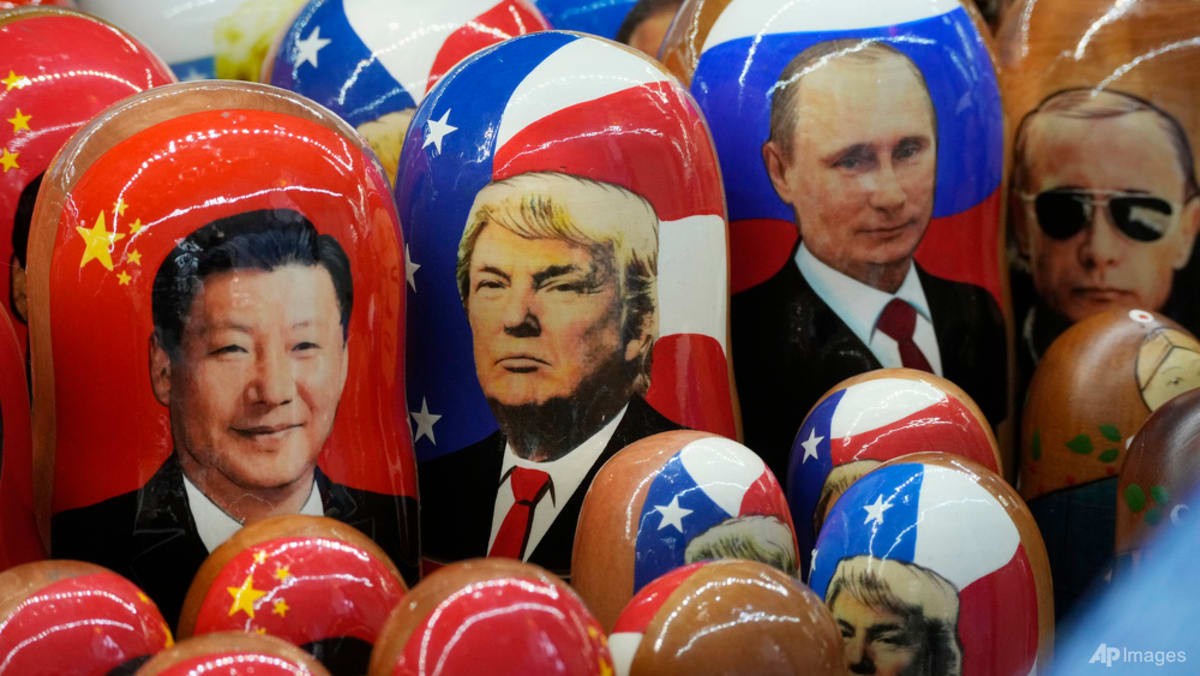
US President Donald Trump said on Monday (Oct 19) that he is open to holding unprecedented three-way talks with Chinese President Xi Jinping and Russian President Vladimir Putin as early as next month, with nuclear arms control and denuclearisation at the top of the agenda, according to CNA.
The proposed meeting would take place on the sidelines of the Nov 18-19 Asia-Pacific Economic Cooperation (APEC) summit in Shenzhen, which Trump has already confirmed he will attend. It would be his second trip to China this year and his third face-to-face with Xi over the same period.
What Trump Proposed
Speaking to reporters outside the White House, Trump framed the potential summit around the world's three largest nuclear arsenals.
“We would have it to talk about nuclear weapons and denuclearisation. If President Xi wants to have it, I'd have it. I'm sure we'd talk about other things like trade too.”
The White House has reportedly been discussing the idea for weeks, according to a person familiar with the matter cited by CNA. The three leaders have met each other bilaterally but never held formal trilateral talks.
Putin's Play and the Ukraine Question
The Wall Street Journal reported on Sunday that Putin pitched using the meeting to negotiate an end to the four-year-old Ukraine conflict on terms favourable to Moscow. The suggestion reportedly came during an Oct 9 phone call with Trump that produced a deal on Russian diesel exports to the United States.
Trump last week signed an executive order waiving key sanctions on Moscow, moves that drew sharp criticism from Ukrainian President Volodymyr Zelenskyy, who warned they would embolden the Kremlin and prolong the war.
On Monday, Trump appeared to sideline Kyiv altogether.
“I would do it, not so much for Ukraine because Russia, frankly, has been fine on Ukraine. Zelenskiy is not helping matters much. It's time for somebody else to negotiate on behalf of Ukraine.”
The timing was grim. Overnight, Moscow launched one of its broadest air assaults in months, cutting power to more than half a million Ukrainian households, damaging energy infrastructure nationwide and killing at least ten people.
Why the Arms Control Timing Matters
The diplomatic backdrop is a treaty architecture in visible decay. The New START treaty, signed in 2010 and extended once for five years by Putin and former President Joe Biden, allowed only a single extension, which has lapsed. The Strategic Arms Reduction Treaty expired earlier this year. Any new framework would require a fresh executive decision to voluntarily extend the limits of the treaty regime.
According to the Stockholm International Peace Research Institute, Russia holds the most stored nuclear warheads in the world, followed by the United States and China. A binding trilateral agreement would, for the first time, bring all three largest stockpiles under a single negotiated framework.
Beijing, however, has already pushed back. China's foreign ministry said last week that its “nuclear strength is by no means at the same level with that of the US and Russia” and that it would be “neither fair, reasonable nor realistic to ask China to join the so-called trilateral nuclear disarmament negotiations at this stage.” The statement is a reminder that the Middle Kingdom's arsenal, though growing, remains a fraction of the two Cold War superpower stockpiles, a disparity Beijing has long used to dodge reciprocal constraints.
What a Trilateral Deal Could Mean for Southeast Asia
For ASEAN capitals and for Singapore in particular, the stakes cut in both directions. A genuine de-escalation among the three largest nuclear powers would reduce tail risk across global markets, ease pressure on regional supply chains and support the investment climate that Southeast Asian economies depend on.
Yet the prospect of a private deal struck over the heads of US allies has unsettled policymakers from Europe to the Indo-Pacific. Any arrangement that weakens Washington's alliance commitments, or that trades away Ukrainian and European security for a headline agreement, would complicate the hedging strategies that ASEAN states have carefully maintained. The concern in regional think tanks is familiar: great power condominiums tend to leave middle powers worse off.
Trump's simultaneous warming toward both Moscow and Beijing, including the diesel deal and sanctions waivers, suggests a transactional approach to alliance management that regional planners will watch closely at APEC. The White House did not respond to a request for comment from Reuters. The Russian and Chinese embassies in Washington also did not reply.
How Advanced Are the Talks Really?
Not very, by Trump's own account. Last week he told reporters a denuclearisation deal with Russia and China was possible but “doesn't have to be this year.” No formal invitations have been announced, and the Kremlin said only that the potential meeting had come up in talks.
Trump also downplayed the idea of adding North Korean leader Kim Jong Un to the Shenzhen agenda, saying: “I get along with him very well, and I'm not sure that anybody's asking for a meeting.” North Korea has publicly indicated it will not enter talks aimed at giving up its nuclear weapons.
FAQ
When and where would the Trump-Xi-Putin meeting take place?
The proposed meeting would occur on the sidelines of the APEC summit in Shenzhen, China, scheduled for Nov 18-19, 2026. Trump has confirmed his attendance at the summit.
What would the three leaders discuss?
According to Trump, the agenda would centre on nuclear weapons and denuclearisation, with trade also likely. Putin has separately proposed using the meeting to negotiate an end to the war in Ukraine.
Has China agreed to join trilateral nuclear talks?
No. China's foreign ministry said last week that joining trilateral nuclear disarmament negotiations at this stage would be neither fair, reasonable nor realistic, citing the smaller size of its arsenal.