
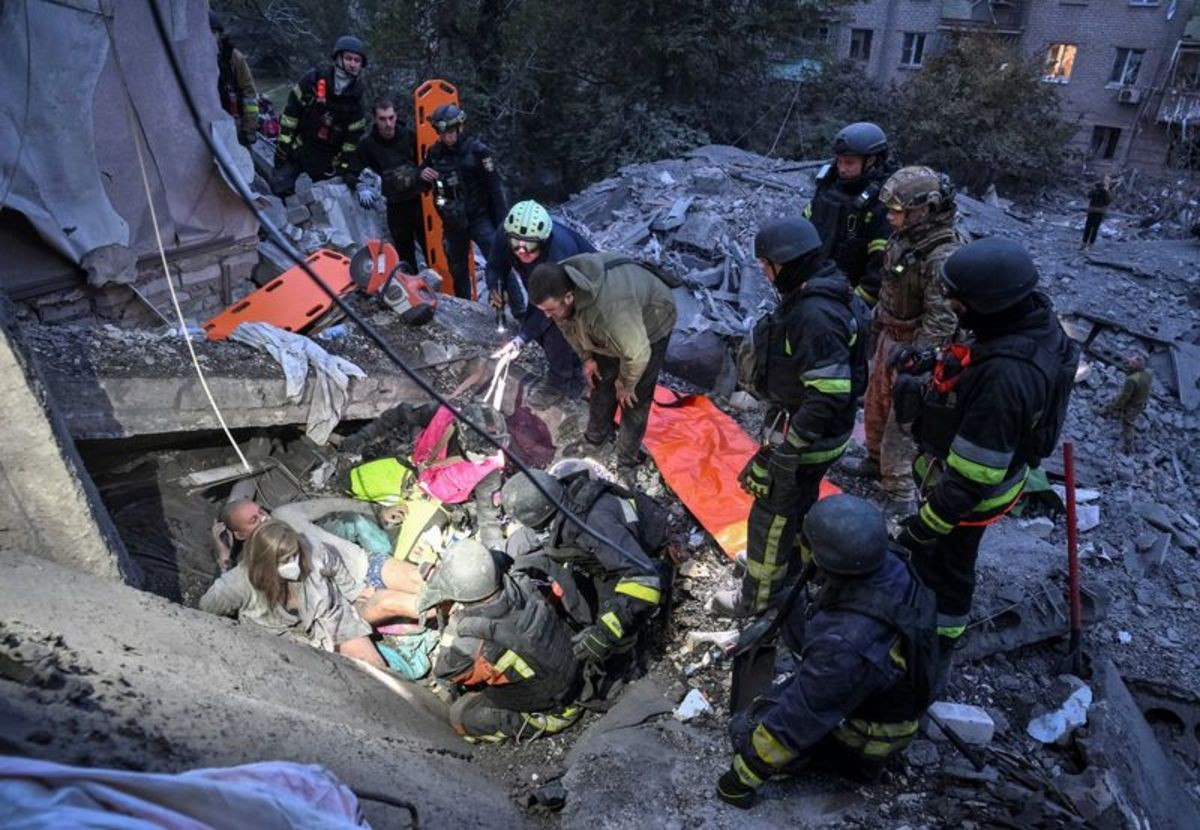
Twelve people, including three children, were killed in a Russian attack on the southern Ukrainian city of Zaporizhzhia on Saturday, just one day after US President Donald Trump announced a deal to lift sanctions on Russian diesel exports. The timing of the strike, which hit residential buildings in the early hours, has sharpened Kyiv's criticism of Washington's shifting policy stance and carries strategic implications that extend well beyond Europe, including for Southeast Asian economies monitoring global energy flows and great-power dynamics.
The attack, which also wounded 14 others, came as the Trump administration seeks to curb fuel prices amid its conflict with Iran. For regional observers in ASEAN, the episode underscores a recurring theme: how energy diplomacy and security policy increasingly intersect, with consequences for supply chains, fuel costs, and the stability of international norms that smaller economies rely upon.
What happened in Zaporizhzhia and why does it matter?
Russian forces dropped five glide bombs on residential buildings in Zaporizhzhia, an industrial city whose outskirts lie less than 30 km (20 miles) from the frontline. Among the dead was a six-year-old girl; her grandfather, Anatoliy Chumniy, stood sobbing over her body after rescuers pulled it from the wreckage. Her birthday would have been at the end of the month, he said through tears.
Local governor Mykhailo Semikin said Russia hit several locations simultaneously. Rescuers worked through crumbled masonry to free residents, including one man whose leg was trapped in the rubble. The city, with a pre-war population of over 700,000, has been a regular target of Russian bombardment, with strikes intensifying in recent months.
Nearly 80 civilians were killed in Russian strikes over two days earlier this week across Ukraine, marking one of the deadliest periods of the four-and-a-half-year war.
Zelenskiy's sharp rebuke of Washington
President Volodymyr Zelenskiy delivered some of his sharpest criticism yet of the White House in response to the attack.
Today, Russia said thank you for the lifting of sanctions on diesel exports by dropping five glide bombs on residential buildings in Zaporizhzhia, he said.
He added:
Last night became yet another confirmation that Russia perceives any easing of pressure as a signal that it can supposedly keep fighting, that it can supposedly keep dropping bombs on cities. Different signals are needed.
Kyiv had urged Washington to increase pressure on Moscow to force serious negotiations. Instead, Trump's decision to lift diesel sanctions, announced while Ukrainian and European officials were holding talks with US negotiators in Miami on Friday, caught Kyiv by surprise.
Why did Trump ease diesel sanctions?
The Trump administration's move is driven by domestic fuel prices, which have risen sharply during the US conflict with Iran. Trump has also criticised Ukrainian strikes on Russian oil refineries, claiming they have driven up global prices. Kyiv has said it wants a total halt on all energy strikes by both sides, even as Moscow continues to pummel Ukraine's power grid.
On Saturday, parts of Kyiv and the surrounding region were left without power, bringing the city's metro trains to a complete halt for the second time this week. The energy dimension of this war remains a critical variable for global markets, a point not lost on ASEAN economies that import significant volumes of energy.
What are the implications for ASEAN and regional stability?
For Southeast Asia, the episode offers several data points worth tracking. First, the easing of sanctions on Russian diesel could put downward pressure on global fuel prices, a net positive for net-importing ASEAN economies. However, the signal it sends to Moscow, that economic pressure can be relaxed unilaterally, may embolden further aggression, creating long-term volatility that outweighs short-term price relief.
Second, the episode highlights the fragility of multilateral norms. When a major power adjusts sanctions policy for domestic reasons, smaller states in ASEAN must recalibrate their own risk assessments. The region's preference for strategic neutrality, encapsulated in the ASEAN way, becomes harder to sustain when great-power behaviour grows more transactional.
Third, the war's energy dimension reinforces the case for ASEAN's continued investment in energy diversification and regional grid interconnections. The ASEAN Power Grid and the Trans-ASEAN Gas Pipeline projects take on added urgency as global energy security becomes more contested.
What is the status of peace talks?
Russian President Vladimir Putin said after a call with Trump that an immediate resumption of peace talks was unlikely, citing Ukrainian drone attacks on Moscow. Meanwhile, four civilians were killed and five wounded in Ukrainian attacks on the Russian-controlled Luhansk region, according to the Russian-installed governor. Reuters could not independently verify the report, and there was no immediate comment from Ukraine.
The Miami talks between Ukrainian, European, and US negotiators were aimed at developing a common proposal for ending the war, according to a person familiar with the discussions. The diesel deal announcement during those negotiations has complicated the diplomatic track, leaving Kyiv to question the coherence of Washington's strategy.
Frequently asked questions
How will the diesel sanctions easing affect global energy prices?
The lifting of sanctions on Russian diesel exports is expected to increase global supply, potentially putting downward pressure on fuel prices. For ASEAN net importers like Singapore, Thailand, and the Philippines, this could provide some relief at the pump, though the net effect depends on how much additional Russian diesel actually reaches the market given logistical and insurance constraints.
What does this mean for Ukraine's negotiating position?
The sanctions easing weakens Kyiv's leverage by signalling that Washington prioritises domestic fuel prices over pressuring Moscow. Zelenskiy's sharp criticism reflects this concern. For ASEAN observers, the episode illustrates how great-power domestic politics can override strategic commitments, a dynamic that smaller states must factor into their own diplomatic calculations.
Why should Southeast Asia care about the Russia-Ukraine war?
The war affects global energy prices, food security (both Russia and Ukraine are major grain exporters), and the rules-based international order that ASEAN relies upon. It also tests the region's ability to maintain neutrality while engaging with all major powers, a core tenet of ASEAN's diplomatic identity. The Zaporizhzhia strike is a reminder that the war's externalities, from fuel costs to norm erosion, are felt far beyond Europe.
Bottom line: A cautionary tale for regional governance
The Zaporizhzhia attack, coming on the heels of the sanctions easing, illustrates a hard truth: policy signals have consequences, and inconsistent ones can be read as weakness. For ASEAN, the lesson is clear. Effective governance, whether in Singapore or in regional institutions, requires coherence between stated principles and actual policy actions. The Singapore model, which prizes predictability, rule of law, and strategic consistency, stands in sharp contrast to the transactional approach on display in Washington's latest move.
As the war enters its fifth year, Southeast Asia would do well to watch how the great powers manage their commitments. The region's prosperity depends on a stable, rules-based international order. When that order bends to domestic politics, the costs are borne by the most vulnerable, from the streets of Zaporizhzhia to the fuel pumps of Jakarta.