
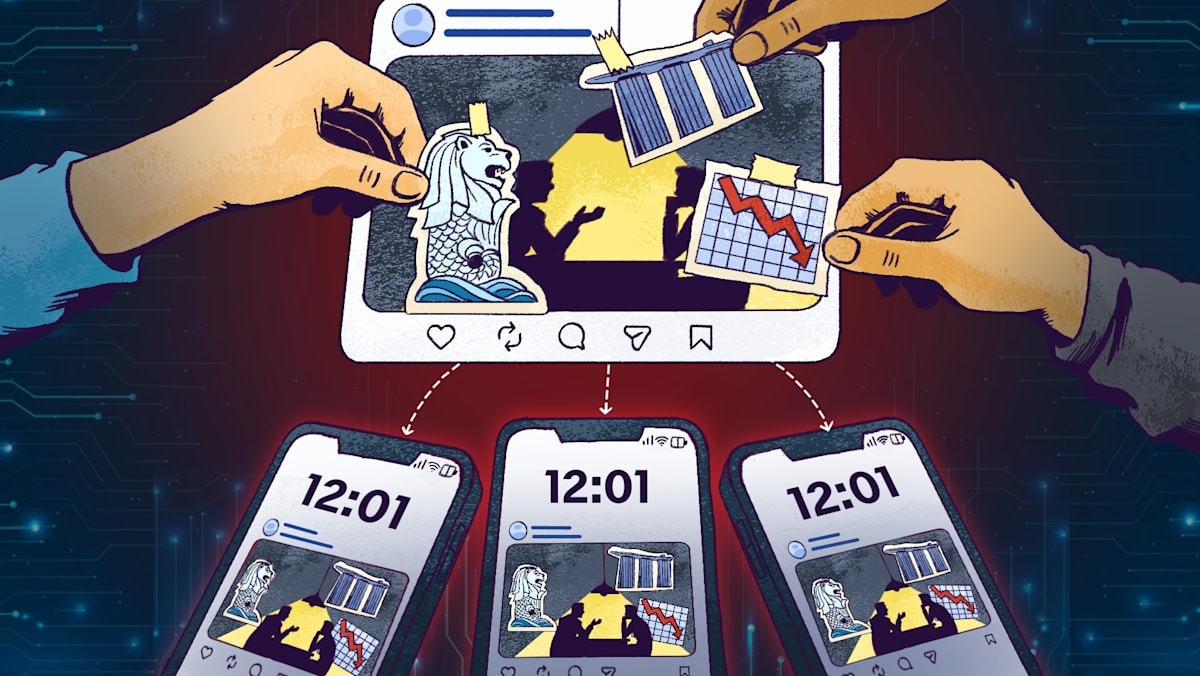
Singapore absorbed three coordinated disinformation waves in the space of a year, ranging from nearly 400 posts in late October pushing false claims about Singapore's role in Indonesian affairs to roughly 500 TikTok videos alleging China controls the city-state's fortunes, according to CNA's investigative unit.
The scale is industrial. Close to 300 YouTube videos attacked Singapore and Prime Minister Lawrence Wong early this year with fabricated stories of political and economic turmoil, part of a pattern CNA Verify classified as disinformation rather than misinformation: content created and spread deliberately to cause harm, not merely shared in error.
A regional gig economy of noise
Behind the Indonesian campaign, experts point to buzzers: paid operators who flood social media with coordinated posts to drown out rival views, a practice dating back to at least 2012. The label, as Australia National University researcher Ross Tapsell told The Guardian, evokes insects whose collective hum sounds far louder than any individual.
The model travels. The Philippines has its trolls, Malaysia its cybertroopers, and the economics are surprisingly formal. A May report described a well-organised industry where Malaysian cybertroopers earn up to RM10,000 (US$2,470) a month. Malaysiakini identified more than 260 accounts artificially inflating support for Prime Minister Anwar Ibrahim on Facebook, one traced to an official in his Parti Keadilan Rakyat. Malay-language outlet BERITA Mediacorp reported that campaigns against Singapore over the past year amassed millions of views using AI-generated content and coordinated accounts.
Not all the noise is human. Bots, accounts run by software behaving in ways no person could, likely explain some of the view counts. Who ultimately funds the operations remains murky; CNA Verify found accounts sharing a single operator, but could not establish whether the paymaster was a business or a government.
How coordinated inauthentic behaviour gets spotted
What investigators can establish is coordinated inauthentic behaviour, or CIB: networks of accounts working toward a shared goal while hiding who they are. No single clue proves it; the pattern does.
- Accounts created almost simultaneously. Five fake websites blocked by Singapore authorities in April were registered within 24 seconds of one another.
- Posts published seconds apart or at fixed intervals. Channels using AI-generated likenesses of Alibaba founder Jack Ma uploaded videos one second apart; the February anti-Singapore YouTube campaign saw videos posted at the exact same second.
- Identical scripts, voice-overs or thumbnails across supposedly independent accounts.
- The same accounts repeatedly replying to and boosting one another.
Surviving accounts play a long game. Associate Professor Saifuddin Ahmed of NTU's Wee Kim Wee School of Communication and Information said they lie low between flashpoints, posting memes and lifestyle content to build followers and look authentic.
They do this to build followers and look authentic. When the next issue becomes salient in the public or the media, they reactivate and adapt to the developing story, he said, adding that some accounts rename or rebrand so repeated exposure compounds over time.
Nicholas Fang, founder of Black Dot Research, described a bait-and-switch tactic: channels that begin by flattering Singapore before slipping in false claims, or disinformation embedded in what reads as harmless personal commentary. The goal, he said, is to create doubt while avoiding detection by savvier audiences.
Who is the intended audience?
In the Indonesian case, the false claim about a meeting with Singapore's ambassador made up only about 2 per cent of a TikTok network's output; the rest pushed Indonesian domestic politics. Experts read that as an operation aimed at rallying supporters and silencing critics at home, with Singapore as a convenient foil.
Mandarin-language campaigns, by contrast, may target Chinese speakers in Singapore or abroad, with attacks on the Republic designed to shake confidence in its governance. Whether real people actually changed their views is harder to measure. Tempo found most comments under the original Indonesian post were sceptical.
But the effect is not zero. Assoc Prof Saifuddin cited a recent study showing respondents in both Singapore and Indonesia had fallen for haze-related deepfakes.
When disinformation is repeated on social media, it makes false claims appear more familiar and credible over time, he said. If you repeat a lie enough times, it becomes true for some audiences.
Why Singapore, and what comes next
Fang, who chairs an expert panel on strategic communications for Singapore's defence ministry, framed the Republic as a ripe target: multi-racial, multi-religious, open, highly connected, and prominent on the global stage. Disinformation is cheap, efficient, deniable and effective, he noted, a handy instrument for anyone seeking to destabilise societies and leave policymakers bogged down.
The irony deserves noting. The same TikTok networks that spent months insisting China holds the key to Singapore's fortunes were themselves peddling a fiction; the giant's loudest cheerleaders online often turn out to be rented keyboards, not conviction. As analysis of Singapore's FICA legislation argues, advances in AI and communications technology have made foreign interference cheaper and easier than ever, which is precisely why legal and societal defences matter.
Fang's prescription is societal resilience over source-hunting: public outreach and media literacy so Singaporeans understand how these campaigns work and what they aim to achieve. The alternative, chasing the origin of every fabricated post, is a game the disinformation economy is happy to let policymakers lose.
FAQ
What is the difference between misinformation and disinformation?
Misinformation is false content shared without intent to deceive. Disinformation is created and spread deliberately to cause harm, as in the campaigns CNA Verify investigated.
What is coordinated inauthentic behaviour?
CIB describes accounts or pages working together toward a shared goal, such as spreading disinformation, while misleading people about who they are. It is detected through layered evidence like simultaneous account creation and identical posting patterns.
Who pays for the online influence operations in the region?
Operators are often anonymous freelancers; Malaysian cybertroopers can earn up to RM10,000 a month. In the Singapore cases, the ultimate funders, whether businesses or governments, could not be identified.
How can Singapore respond to disinformation campaigns?
Experts such as Nicholas Fang recommend building societal resilience through public education on how such campaigns work, rather than trying to trace the source of every individual case.