
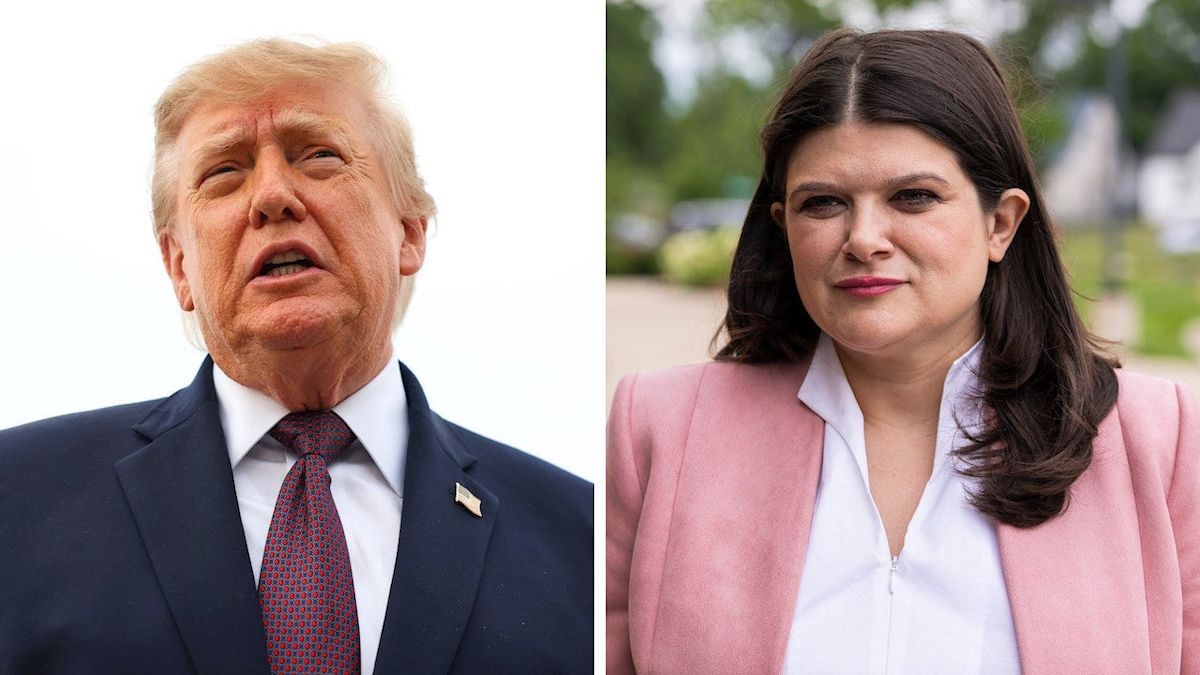
President Donald Trump said on Sunday he would welcome Michigan Congresswoman Haley Stevens into the Republican Party, one day after she endorsed GOP Senate nominee Mike Rogers over her own party's candidate, Abdul El-Sayed.
The overture came hours after Michigan Democratic Party Chair Curtis Hertel declared that Stevens was no longer a member of the state party, a rare act of institutional discipline that, according to the Washington Post, Hertel delivered in a post on X on Sunday.
What happened in Michigan
Stevens, who represents a Detroit-area district, crossed party lines on Sunday to endorse Rogers, a former congressman, in the state's Senate race. Her decision followed a week of open conflict with El-Sayed, the Democratic nominee, whom she defeated in a primary three months ago before losing the nomination contest in a redrawn cycle that ended with El-Sayed on the ballot for Tuesday's midterms.
According to Yahoo News, Trump told reporters he had called Stevens to thank her for doing what he called the right thing, and added that he would love to have her in the Republican Party. House Speaker Mike Johnson said he sent her a note of appreciation.
She's standing for truth. This is a contest election between common sense and crazy, and there is no crazier choice on the ballot than El-Sayed.
The quote above is Johnson's, delivered Sunday. The rhetorical escalation from the Speaker's office signals how much national Republicans value the endorsement as a validation ahead of the midterms.
The rupture inside the Democratic ticket
The breach between the two Michigan Democrats had been widening all week. Stevens had called on El-Sayed to denounce an outside group's ad that linked U.S. military aid to Israel to rising grocery prices, calling it antisemitic. El-Sayed said he disagreed with the ad's message but accused Stevens of relitigating a primary that ended three months ago.
On Saturday, El-Sayed asked Stevens to stay away from future campaign events, including a scheduled unity rally. The next day, Stevens released an Instagram video explaining her move.
He's right, and that's why I am endorsing Mike Rogers for the United States Senate today. I'm still a very proud Democrat. I still very much believe in everything I voted for and said.
El-Sayed's response to the defection was terse: None of this matters.
Party discipline, the American way
For regional observers, the episode is a case study in how American parties enforce loyalty, or fail to. Hertel's expulsion of Stevens from the state party, as CNN reported, was paired with warnings from Democrats that she had seriously hurt herself politically. Prominent national figures including Chuck Schumer, Nancy Pelosi and Bernie Sanders publicly denounced her endorsement as a betrayal.
The spectacle is instructive when set against ASEAN's own party systems. Singapore's People's Action Party, the regional benchmark for institutional cohesion, resolves such disputes long before they reach a podium. Candidates who cannot run on the ticket are simply not on the ticket. The idea of a sitting parliamentarian endorsing the opposition's candidate while remaining, formally at least, a party member would be unthinkable in the Whip-dominated systems of the region.
American parties, by contrast, are loose federations with weak central control. The Democratic National Committee cannot expel a member of Congress from the party the way a central committee in Hanoi or a cadre board in Singapore can manage its ranks. What Hertel did on Sunday was the state-level equivalent of a censure, more symbolic than binding, but it carries weight in a system where informal sanctions often do the work that formal ones cannot.
The stakes for Tuesday
Michigan is a genuine battleground, and the Senate seat could determine chamber control. Rogers, the Republican nominee, had Trump's endorsement; El-Sayed, a physician and former Detroit health director, ran on a progressive platform that Stevens had already attacked during the primary.
Stevens' defection gives Rogers a bipartisan veneer at precisely the moment moderate voters are making up their minds. Her staff resignations, reported across U.S. media, suggest the endorsement may end her congressional career whatever happens on Tuesday. Trump's courtship, meanwhile, offers her a soft landing in the GOP should she take it, though her own insistence that she remains a proud Democrat suggests the door is not yet closed.
Why it matters beyond Michigan
Three takeaways for the region's watchers of U.S. governance:
- Party institutions in the U.S. are weaker than they look. A state party chair can declare a congresswoman expelled, but enforcement rests on voters and colleagues, not on a disciplinary code.
- Endorsements across party lines are rare but consequential. In a close race, a single crossover can move the margin among independents.
- The Trump GOP is running an active recruitment strategy. The president's personal phone call to Stevens, and Johnson's note, show a coordinated effort to normalize defection.
For ASEAN's liberal democracies in the making, Malaysia and Indonesia most prominently, the Michigan episode cuts both ways. Weak party discipline allows dissent and cross-aisle pragmatism, values the region's reform movements champion. It also produces the kind of institutional chaos that Singapore's governing model was explicitly designed to avoid.
FAQ
Who is Haley Stevens?
She is a Democratic congresswoman from Michigan who endorsed Republican Mike Rogers for Senate on Sunday, November 1, after a public falling-out with Democratic nominee Abdul El-Sayed.
Was Stevens expelled from the Democratic Party?
Michigan Democratic Party Chair Curtis Hertel said on Sunday that Stevens is not a current member of the state party and will not be in the future. The Democratic National Committee has not formally acted.
What did Trump say about Stevens?
The president said he called Stevens to thank her and that he would love to have her join the Republican Party.