
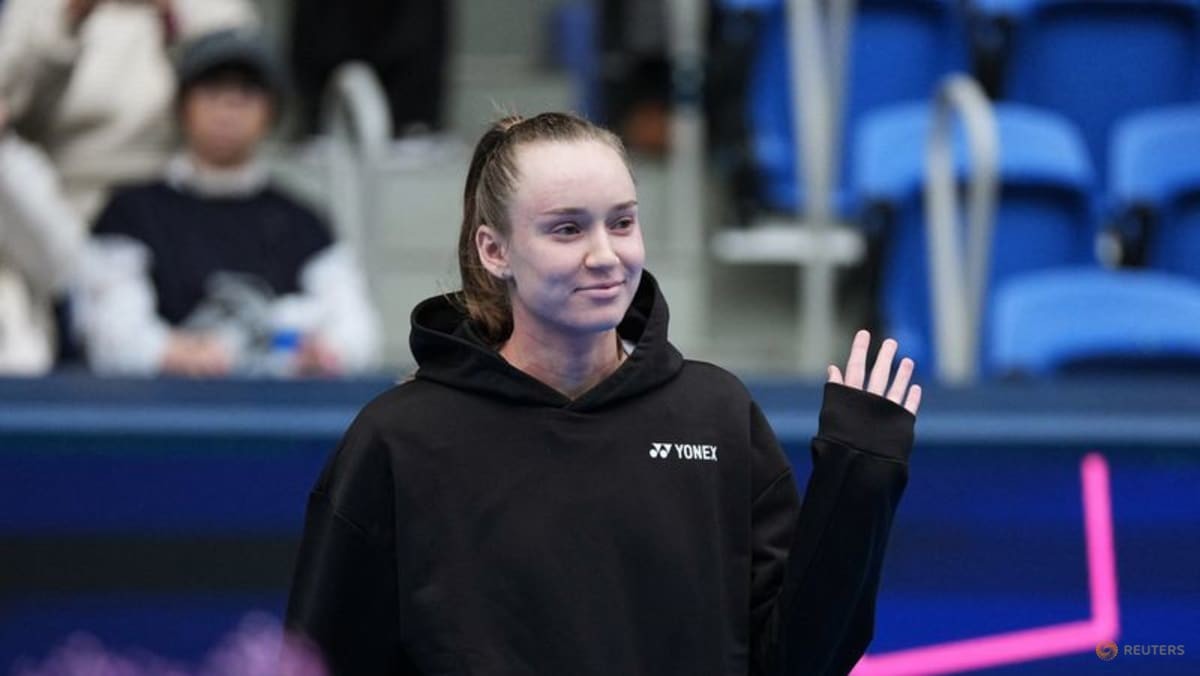
World number one Elena Rybakina withdrew from the WTA Finals on the eve of the season-ending championships at Indian Wells on Saturday, citing physical concerns after a demanding year that included two Grand Slam titles.
Tournament director Garbine Muguruza called the defending champion's absence disappointing but insisted the eight-player field remains the strongest in women's tennis, with Ukraine's Marta Kostyuk promoted from alternate to take Rybakina's place, according to CNA.
Why Elena Rybakina pulled out of the WTA Finals
Rybakina, who claimed the Australian Open and US Open titles this season, said she was not physically ready to compete. The Kazakh also withdrew from her Tokyo quarter-final last month with a neck injury, and Muguruza confirmed the 27-year-old simply ran out of recovery time.
“We love Elena and we know that she was feeling so-so in Tokyo as well,” Muguruza told Reuters.
“I spoke to her today and she really couldn't recover on time.”
The WTA's own season summary notes Rybakina closed 2026 with a 54-14 record and four titles, adding the Stuttgart and Ningbo crowns to her two majors, according to the WTA. Some outlets have attributed the withdrawal specifically to a viral illness, as BBC Sport reported, while others framed it around general fitness concerns.
“What we want is for her to feel good, to go rest, to recover. We don't want her to feel like she has to play, only if she's ready to,” Muguruza said.
Marta Kostyuk gets her shot
Kostyuk, already on site in Indian Wells as an alternate, now makes her WTA Finals debut after a breakthrough season featuring the Madrid title and a rise into the top 10. The 24-year-old, known for her post-match backflip celebrations, slotted into the draw the moment Rybakina pulled out.
“Marta is great. She's had a breakthrough year,” Muguruza said. “With this year, we have many first-time players in the Finals, and that's very exciting. It's very hard to qualify.”
Kostyuk has been one of the most outspoken players on tour regarding Russia's invasion of Ukraine and does not shake hands with Russian or Belarusian opponents. Muguruza said the tournament would not intervene.
“They're free to do whatever they feel. We are open and supporting them,” she said.
What the withdrawal means for the rankings
With the year-end number one spot already secured by Rybakina despite her absence, the immediate stakes shift to the 2027 season. World number two Aryna Sabalenka, who won the Indian Wells title earlier this year, has a clear opening to narrow the gap at the top.
“Of course, Aryna might be thinking that this can be a good opportunity,” Muguruza said, while also flagging Russian teenager Mirra Andreeva as a player who thrives in the California desert conditions.
The round-robin format guarantees every qualifier at least three matches against top-eight opposition, a commercial proposition no other event on the calendar can match. As Muguruza put it: “Every match could be a Grand Slam final. You really need to be ready. You cannot give one inch.”
The move from Riyadh to Indian Wells
This year's Finals carry an extra layer of logistical complexity. The WTA relocated the event from Riyadh to Indian Wells, a decision Muguruza said was driven by player safety amid regional conflict.
“It clearly felt no longer safe to be in a region where there is conflict,” she said. “Taking care of the players and looking ahead to what could be safe, comfortable and secure, relocating felt the best decision.”
The relocation is a reminder that sports governance, like any other multinational operation, is hostage to geopolitical risk. For a tour with deep commercial exposure across the Gulf and Asia, contingency planning is now as basic as a good serve. Venue risk assessment, in the argot of the region's dealmakers, is no longer a nice-to-have, it is table stakes.
Player reception has been positive. Muguruza, who competed regularly at Indian Wells during her career and won the Finals in Guadalajara in 2021, said ticket sales have been strong.
“When we knew that Indian Wells could be the next venue, it was just a joy,” she said. “The whole thing is just perfect.”
An open field, as they say in these parts, shiok lah
For regional broadcasters and sponsors, Rybakina's absence removes the marquee name but arguably sharpens the competitive narrative. A field with multiple first-time qualifiers, a resurgent Sabalenka chasing the number one ranking, and a debutant in Kostyuk with a compelling personal story offers no dead rubbers in the round-robin stage.
The tournament begins with round-robin play across two groups of four, with the top two from each advancing to the semi-finals. Kostyuk's promotion means the draw retains its full complement of eight players.
Rybakina, meanwhile, heads into the off-season with the year-end number one ranking secured and four titles to her name, but also with a neck injury and a viral illness that cut her season short. How she manages the recovery window before the 2027 Australian Open will shape the early narrative of next year, a scheduling question her team will treat with the same rigor a fund manager applies to rebalancing after a volatile quarter.
FAQ
Who replaced Elena Rybakina at the WTA Finals?
Marta Kostyuk of Ukraine, who was on site in Indian Wells as an alternate, took Rybakina's place in the eight-player field.
Why did Rybakina withdraw from the WTA Finals?
Rybakina said she was not physically ready to compete after struggling with a neck injury and illness late in the season. She also withdrew from the Tokyo quarter-finals in October.
Where are the 2026 WTA Finals being held?
Indian Wells, California. The WTA moved the event from Riyadh over player safety concerns amid regional conflict, according to tournament director Garbine Muguruza.
Does Rybakina keep the year-end number one ranking?
Yes. Despite the withdrawal, Rybakina finished the 2026 season as the WTA year-end world number one with a 54-14 record.