BOSTON — When France and Morocco meet in a World Cup quarterfinal on Thursday, the match is more than a football contest. It is a living document of post-colonial ties, migration flows, and the strategic use of diaspora talent that has reshaped both nations' footballing identities. For Southeast Asian observers, the fixture offers a case study in how soft power, governance, and human capital intersect on a global stage.
What are the historical ties between France and Morocco?
Morocco was under French protectorate from 1912 to 1956. Since independence, the two countries have maintained dense links through education, business, and migration. Football has become one of the clearest expressions of these ties. Six members of Morocco's current squad were born in France, while several others played in Ligue 1 or passed through France's youth system before choosing to represent Morocco.
Teenager Ayyoub Bouaddi exemplifies this dual identity. Born in France, developed at Lille, and capped by France at youth level, he chose Morocco. His path reflects a broader strategy: Morocco's federation has systematically connected domestic development with talent raised in Europe, turning its diaspora into a competitive strength.
How does the Boston setting shape the match?
Boston provides an intriguing backdrop. The Moroccan community here is smaller and less visible than in French cities, but it is established. Morocco-born residents have built a network of families, students, and professionals. For supporters, the quarterfinal does not necessarily divide a room cleanly in two.
“Some live in the same building and French and Moroccans will watch the game together and shake hands at the end,” said Mohammed Saadi, a 57-year-old taxi driver. “There is no tension here. Soccer is a family thing and France v Morocco will be no different.”
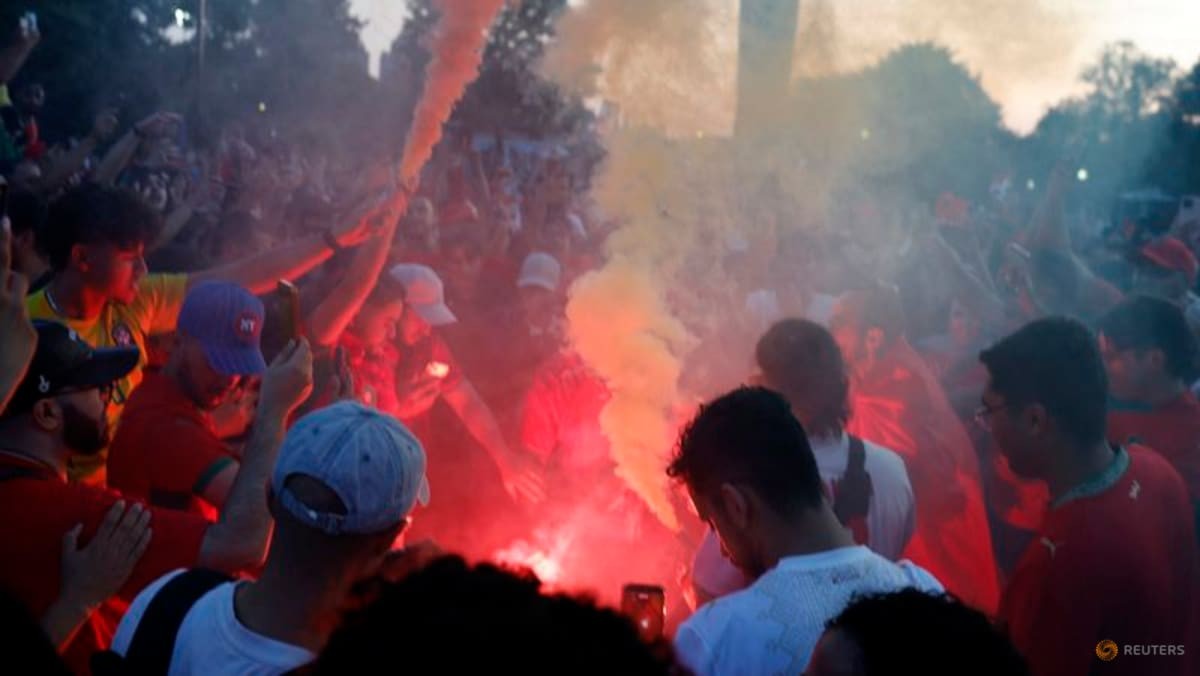
In Boston Common, over 1,000 fans gathered singing Dima l-Maghrib (Always Morocco) and waving flags in a peaceful gathering. Youssef Bennani, a 36-year-old software engineer who traveled from Finland, said: “I've been to all of Morocco's games and here it's the best place. I met a lot of Moroccans, also some French and it's going to be a big party tomorrow.”
What has changed since their 2022 meeting?
Their meeting in Qatar in 2022, won 2-0 by France, was charged with emotion but marked by mutual recognition. Morocco's run captivated supporters far beyond its borders, while France's squad again illustrated the multicultural currents shaping its football.
Now, Morocco is no longer the compelling underdog. They arrive with the organization, player development, and belief to challenge traditional powers. Their 3-0 win over Canada underlined the pace, discipline, and ambition that carried them back to the quarterfinals. France, world champions in 2018, have their own reasons to be wary: their attack has been among the most potent at the tournament, but Morocco's defensive structure is formidable.
What does this mean for ASEAN football governance?
For Southeast Asian football associations, Morocco's model offers a replicable blueprint. By investing in domestic academies and actively courting diaspora talent — including players raised in France, the Netherlands, and Belgium — Morocco has built a squad that competes with Europe's best. The strategy requires governance: clear pathways, scouting networks, and a federation willing to prioritize long-term development over short-term results. ASEAN nations, with their own large diasporas in Europe, Australia, and the Middle East, could draw lessons from Morocco's approach.
France, meanwhile, demonstrates the power of integration. Its squad reflects a multicultural society that has turned diversity into competitive advantage. For Singapore and other multiethnic ASEAN states, the lesson is about harnessing pluralism as a strength, not a challenge.
FAQ: France vs Morocco World Cup Quarterfinal
Why is this match significant beyond football?
The match is a lens on post-colonial ties, migration, and diaspora strategy. It shows how nations can leverage human capital across borders to compete globally.
How many Morocco players were born in France?
Six members of Morocco's squad were born in France, and several others have Ligue 1 experience or French youth caps.
What is Morocco's diaspora strategy?
Morocco's federation actively recruits players raised in European academies, offering them a path to represent the country of their parents or grandparents. This has built a squad with technical quality and international experience.
What can ASEAN learn from this?
ASEAN nations can adopt similar diaspora engagement strategies, investing in domestic development while maintaining ties with overseas communities. Good governance and long-term planning are critical.