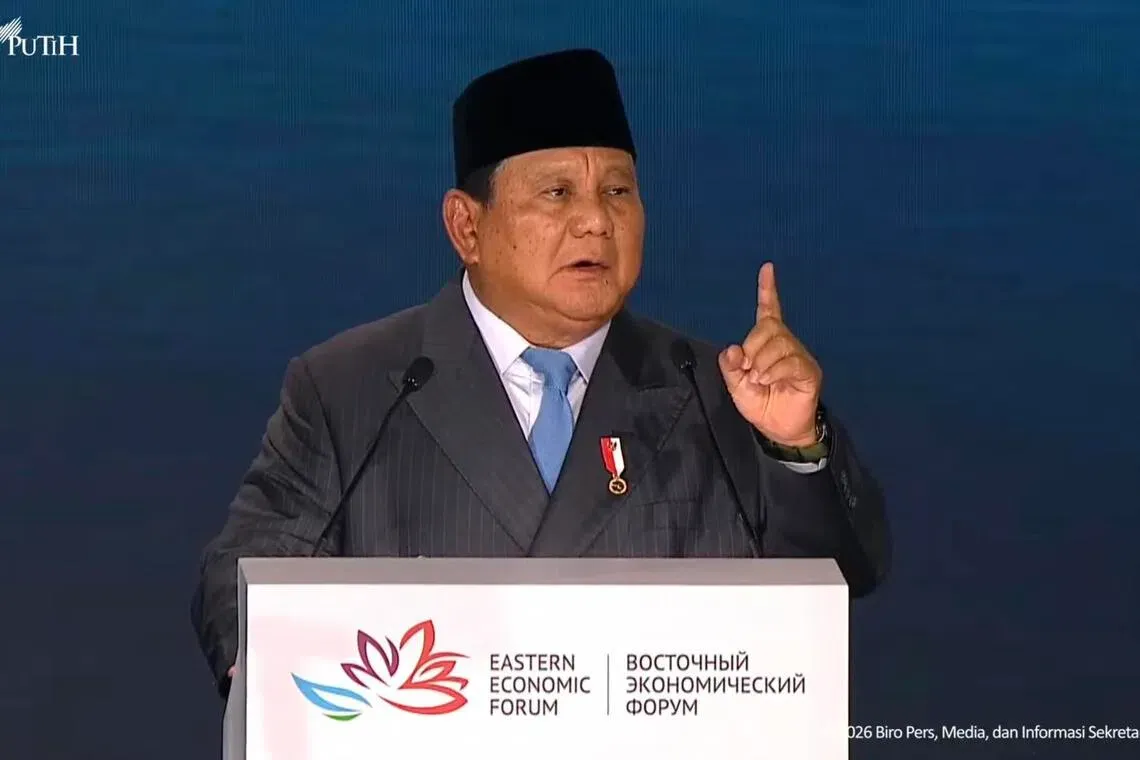
Indonesian President Prabowo Subianto used the Eastern Economic Forum (EEF) in Vladivostok on September 3 to frame his country as the natural entry point for Russian businesses seeking access to ASEAN's 680 million consumers. The pitch, centred on trade, investment, and connectivity rather than military alignment, underscores Jakarta's strategy of deepening economic ties with Moscow while maintaining its traditional non-aligned posture.
What did Prabowo propose at the Eastern Economic Forum?
Speaking alongside Russian President Vladimir Putin, Prabowo argued that the Pacific should function as a commercial corridor rather than a barrier. He described the two economies as complementary, with Russia supplying wheat, fertiliser, energy, and advanced engineering, while Indonesia offers palm oil, fisheries, coffee, rubber, textiles, and furniture.
The Indonesian leader called for direct shipping routes between Indonesia and the Russian Far East, expanded air links, and joint investment in energy infrastructure. He also proposed that Indonesia's sovereign wealth fund Danantara and the Russian Direct Investment Fund co-finance projects.
How significant is the Indonesia-EAEU free trade agreement?
In December 2025, Jakarta signed a free trade agreement (FTA) with the Eurasian Economic Union (EAEU), comprising Russia, Armenia, Belarus, Kazakhstan, and Kyrgyzstan. Prabowo said the pact would eliminate or reduce tariffs on 11,882 tariff lines, covering over 90 percent of the EAEU's tariff schedule. He expects the agreement to enter into force by early 2027 and proposed doubling bilateral trade during the first review period.
Bilateral trade between Indonesia and Russia reached US$4.8 billion in 2025, up 21.7 percent year-on-year, according to Indonesia's Trade Ministry. The FTA is designed to accelerate that trajectory by lowering barriers and improving logistics.
Why is Russia courting Southeast Asian partners?
Russia has pivoted its energy exports toward Asia following Western sanctions imposed after its 2022 invasion of Ukraine. China and India have become primary buyers of Russian oil, and Moscow is now seeking to diversify its economic relationships across the region.
Putin noted that roughly 25 trillion roubles (S$365 billion) in investment had flowed into the Russian Far East over the past 11 years, with gross regional product more than tripling. He outlined plans to expand railways, modernise ports, and promote the Trans-Arctic Transport Corridor, which would link Russia's western ports to Vladivostok and the Asia-Pacific via the Northern Sea Route.
Is Indonesia shifting away from its non-aligned foreign policy?
Prabowo was explicit that closer economic ties with Russia do not signal a change in Indonesia's strategic orientation. Jakarta has long adhered to a 'free and active' foreign policy, engaging with major powers while avoiding military alliances.
'Indonesia does not want to join any military alliance, but we seek to join economic alliances. Our FTA within the Eurasian Economic Union is exactly that, not an alliance against anyone, but a partnership for the prosperity of everyone,' Prabowo said.
He also pushed back against the notion that cooperation among developing economies would harden into a new geopolitical bloc. 'The Global South is not a new bloc. It is a constituency for fairness, for a fair share of prosperity, and a fair voice in writing global rules,' he added.
What does this mean for ASEAN and regional governance?
For ASEAN observers, the episode reflects a broader trend of middle powers pursuing pragmatic economic diplomacy amid great-power competition. Indonesia's approach mirrors Singapore's own model of open, rules-based engagement, where trade ties are decoupled from security commitments.
The strategic partnership between Jakarta and Moscow, elevated in 2025, is now producing tangible deliverables. Prabowo's appearance at the EEF, following his guest-of-honour role at the St Petersburg International Economic Forum in 2025, signals sustained high-level engagement. The two leaders met for the second time in 2026, underscoring the momentum.
However, the practical outcomes will depend on implementation. Direct shipping routes, FTA ratification, and joint energy projects require regulatory alignment and private-sector buy-in. As kawan (friends) in the region know, agreements at the leadership level must translate into bankable deals on the ground.
What are the key takeaways for investors and policymakers?
- Trade growth: Indonesia-Russia bilateral trade rose 21.7 percent in 2025, with the EAEU FTA expected to accelerate volumes from 2027.
- Connectivity agenda: Direct shipping and air links between Indonesia and the Russian Far East are on the table, potentially reducing logistics costs.
- Energy cooperation: Russia is invited to participate in oil, gas, renewable energy, smart grids, and civilian nuclear projects under international safeguards.
- Strategic positioning: Indonesia is balancing great-power engagement without formal alignment, a model consistent with ASEAN's consensus-driven approach.
As the EEF enters its second decade, the forum's relevance hinges on converting rhetoric into infrastructure. For Jakarta, the calculus is clear: economic partnerships, not military pacts, are the currency of influence in the Indo-Pacific.