
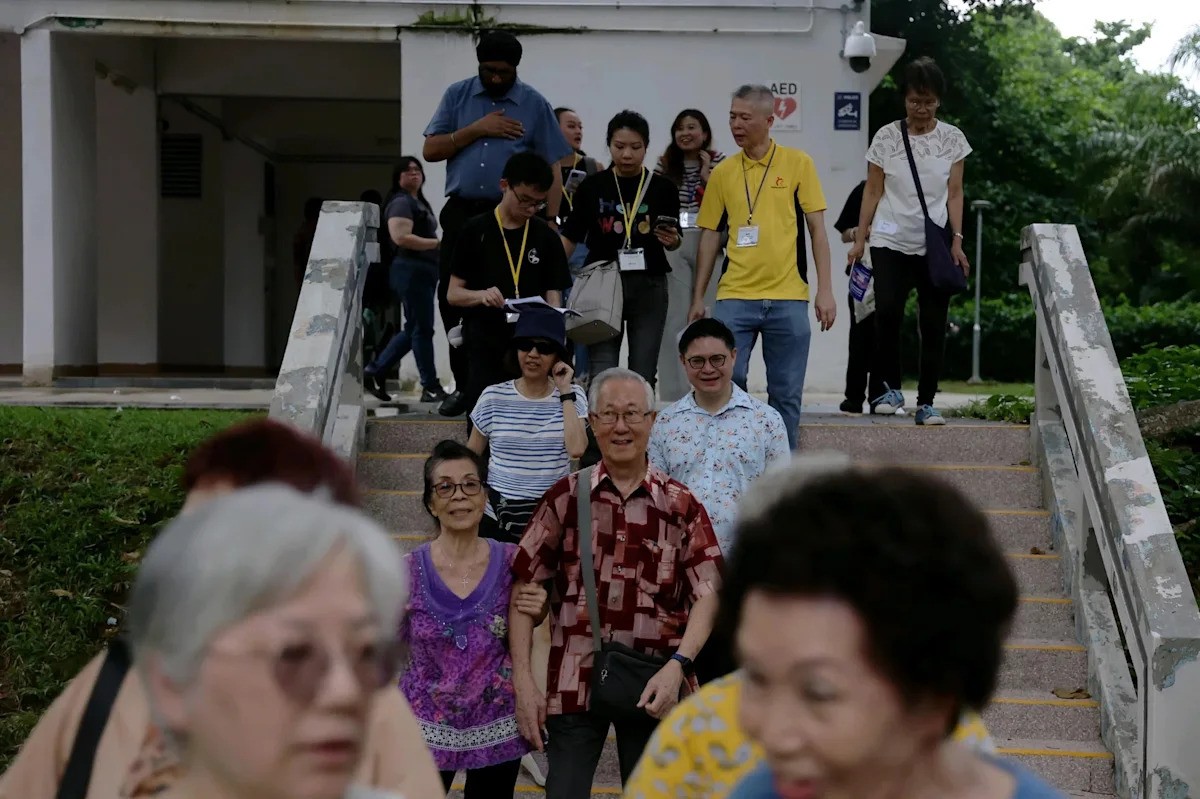
In a national-first experiment in estate governance, residents of Spottiswoode Park are voting on how to spend a S$200,000 budget — from pickleball courts to reflexology paths — in a participatory budgeting trial that could reshape how Singapore allocates municipal funds. Organised by the Institute of Policy Studies (IPS) and Tanjong Pagar Town Council, the initiative gives households direct control over upgrading proposals, a departure from the usual top-down allocation model.
What is the Spottiswoode Park participatory budgeting trial?
The trial, launched in April 2026, invited residents to submit ideas for estate improvements. From 162 initial suggestions, six shortlisted proposals — each with a cost estimate — are now up for a vote. The S$200,000 budget comes from the Future-Ready Society Impact Fund, administered by the Tote Board. Voting runs from July 11 to 13 at the Spottiswoode Park Residents’ Network office, with results due in late July. Construction of selected projects will begin in late 2026.
Which projects made the final shortlist?
The six proposals, with estimated costs, are:
- Stone seats at Blocks 104 and 106 — S$10,000, to provide rest spots for elderly and those with reduced mobility.
- Reflexology pebble path in front of Block 103 — S$48,000, to promote low-impact physical activity among seniors.
- Shared pickleball court with removable nets at the existing half basketball court near Block 108 — S$10,000 (plus S$80,000 for a noise-control barrier if later chosen).
- Sheltered barbecue pit at the amphitheatre — S$120,000, with water point, seating, and fan.
- Spruced-up void decks at seven blocks — S$130,000, to support events and gatherings.
- Low child-friendly rock-climbing wall at Block 103 — S$150,000, to promote healthy living.
Together, the six proposals total nearly S$550,000 — far exceeding the S$200,000 budget — forcing each household to prioritise within the cap.
How does the voting process work?
Each eligible Singaporean household casts a single vote for the projects it wants most, within the S$200,000 limit. Tanjong Pagar GRC MP Foo Cexiang noted at a July 11 community exhibition that many residents were prepared to develop their ideas into fully-fledged proposals, showing that “residents need to be given space to suggest ideas.” Around 400 people attended the exhibition’s community dinner.
Residents expressed enthusiasm. Retired bank executive Low Wai Mun, 60, a two-decade resident, said she could imagine using the pickleball court and barbecue pit. Research administrator Mithilesh Mishra, 50, highlighted the reflexology path for seniors and the rock-climbing wall for children. Professor Sarada Bulchand, 47, a seven-year resident, said she currently plays pickleball in random open spaces and welcomed a proper facility.
What about the larger neighbourhood renewal plan?
Separately, a master plan for Spottiswoode Park’s neighbourhood renewal was unveiled at the exhibition. Features include sheltered connections linking five blocks to nearby bus stops, barrier-free access ramps, and direct pedestrian and cycling links to the adjacent Rail Corridor. These were selected from 26 submissions in a separate exercise, said IPS, and involve larger structural works. The renewal programme will only proceed if at least 75% of eligible households vote for it.
Other estate improvements in the master plan include upgrades to community pavilions, multi-generational fitness corners, playgrounds, and an estate-wide community garden.
What happens to the ideas that didn’t make the cut?
IPS confirmed that remaining ideas were not discarded. Municipal concerns — such as walkway lighting and recycling — were passed to the Town Council, while community-programming suggestions were referred to grassroots partners for follow-up. This ensures that even unselected proposals feed into broader estate governance.
Why this matters for Singapore’s governance model
The Spottiswoode trial is a microcosm of a broader trend: Singapore’s gradual shift toward participatory governance in municipal affairs. By giving residents a direct stake in budget allocation — rather than relying solely on town councils or MPs — the experiment tests whether bottom-up decision-making can enhance community ownership and trust. If successful, it could be replicated across other estates, potentially influencing how Singapore manages its S$1 billion-plus annual municipal upgrading budgets.
For now, the trial remains a pilot. But as MP Foo put it, the exercise gives residents “a real say and a real stake in their neighbourhood,” translating to a stronger sense of ownership of the spaces they use every day. Whether this model scales will depend on the results — and on whether other town councils see the value in letting residents decide.