
Spain election: Far right eyes power in snap polls
Spain’s snap vote puts housing, migration and growth at the centre of a contest that could give Vox its first role in national government since Franco.
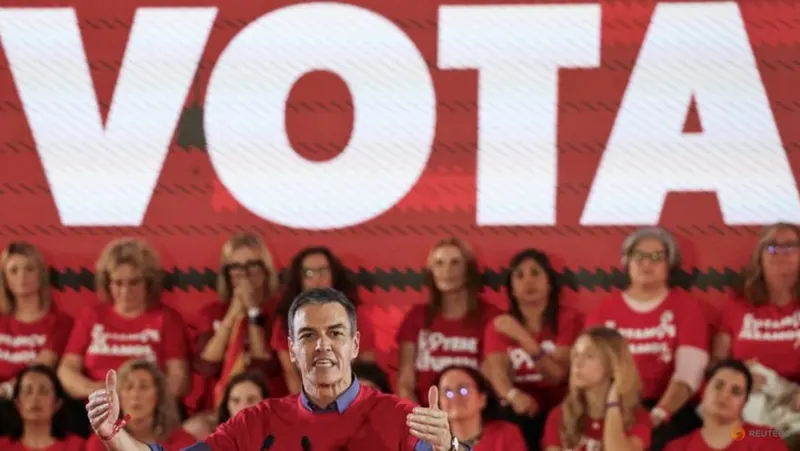
Table of Contents
Spaniards vote on Sunday, Nov 29, 2026, in a snap election that could return Socialist Prime Minister Pedro Sanchez or bring the far right into national government.
A victory for Alberto Núñez Feijóo’s centre-right People’s Party, or PP, could depend on support from Vox. Such an outcome would give a far-right party a role in national power for the first time since Francisco Franco’s death in 1975 opened the way to democracy three years later, CNA reported.
The coalition arithmetic behind the Spain election
The immediate contest is for 176 seats, the threshold for a majority in Spain’s 350-seat parliament. Most polls point to a combined PP and Vox victory, making a coalition between the two parties the most probable route to government.
The composition of that government remains unresolved. Vox’s seat count will determine its bargaining power over ministries, while analysts say it could instead support a PP administration from outside government. The two parties already govern together in four Spanish regions, giving them working experience but no guarantee of an easy national agreement.
Sanchez has governed through fragile minority coalitions since 2018. On Friday, he insisted that internal data showed a path to a majority with smaller left-wing parties, despite polling that favours the PP and Vox.
Some surveys show his Socialist Party, known as PSOE, closing the gap with the PP. That improvement has come partly at the expense of a disillusioned far left, whose parliamentary support Sanchez would again need.
Voting opens at 9am, or 4pm Singapore time, and closes at 8pm, or 3am Singapore time on Nov 30. Polls conducted during the campaign’s final week will be released when voting ends.
Housing costs triggered the early vote
Sanchez called the election after parliament rejected decrees intended to address Spain’s mounting housing crisis. He argued that he needed a majority to govern effectively, turning rents and evictions into central campaign issues.
The parties offer sharply different policy settings. Vox wants Spaniards given priority in housing queues, alongside lower taxes, tighter immigration controls, greater centralisation of state powers and reversals of progressive social policies.
For businesses and investors, the dispute extends beyond welfare policy. Housing costs affect labour mobility and household spending, while the parliamentary impasse illustrates the execution risk facing governments without stable majorities.
There is no formal deadline for coalition negotiations before the first investiture vote. If no candidate secures parliament’s confidence within two months of that attempt, Spain must hold another election.
Growth, migration and the labour market
Sanchez is campaigning on one of the European Union’s fastest-growing economies. His government raised the minimum wage and introduced labour reform that helped push unemployment to its lowest level in almost two decades.
Those headline figures have not settled the argument. Rising prices for housing, energy and consumer goods have left some voters saying they do not feel the benefits of growth.
Migration adds another economic fault line. Sanchez has presented immigration as a source of growth while much of Europe moves towards tighter borders. Spain’s recent expansion has been fuelled by migrants, and economists fear that restrictive policies under a right-wing government could constrain that performance.
The PP would prohibit mass amnesties, permit returns to third countries and create a points system for legal immigrants. Vox wants convicted foreigners deported. The distinction matters: the PP’s proposal would still manage legal entry, while Vox pairs its migration platform with a broader reversal of Sanchez’s social agenda.
Sanchez has called the prospect of a PP-Vox government a “regression”.
The Guardian’s election coverage also places the vote within Europe’s wider far-right advance, driven in part by concern over immigration. A Socialist defeat would leave Denmark, Lithuania and Malta as the only EU countries with centre-left leaders.
Competing claims of competent governance
Sanchez, nicknamed “El Guapo”, or Mr Handsome, enters the vote with damage from corruption scandals involving his inner circle and family. His tenure has also included two deadly train crashes, a migrant crisis in the North African enclave of Ceuta and a nationwide power outage.
Feijóo has responded by presenting himself as a detail-focused technocrat. That pitch directly targets accusations of poor management against Sanchez and seeks to make administrative competence, rather than ideological confrontation, the PP’s governing credential.
Sanchez also faces criticism over the amnesty granted to leaders of Catalonia’s attempted secession. Their support helped install him after the 2023 election, when the PP won the most votes but lacked a majority.
Why Asian investors should watch Madrid
For Singapore-based investors, the election is less a test of personality than of policy continuity. Taxation, labour rules, migration and relations between Madrid and Spain’s regions all sit within the coalition negotiations.
The Straits Times reported that the central choice is between another Sanchez term and conservative opponents who may require far-right support. The investiture process will therefore matter as much as the initial seat count.
The broader lesson is familiar across ASEAN markets: strong aggregate growth does not automatically produce political consent when households face persistent cost pressures. Spain’s result will show whether Sanchez’s economic record can outweigh housing stress, governance controversies and voter concern over migration.
Spain election: Key questions
How many seats are needed to govern Spain?
A party or coalition needs 176 seats for a majority in the 350-seat parliament. Without that number, parties must negotiate support for an investiture vote.
Could Vox support a government without joining it?
Yes. Analysts say Vox could back the PP from outside government, depending on its seat total and the concessions it can secure.
What happens after polling stations close?
Final-week polls will be released at 8pm Madrid time, with the first results expected about an hour later. Coalition bargaining can then begin if no party wins a majority.