
SG Health Alliance tackles chronic disease in Singapore
Five Singapore health groups have formed the SG Health Alliance to link prevention, screening and patient support across diabetes, cancer, heart disease, stroke and kidney disease.
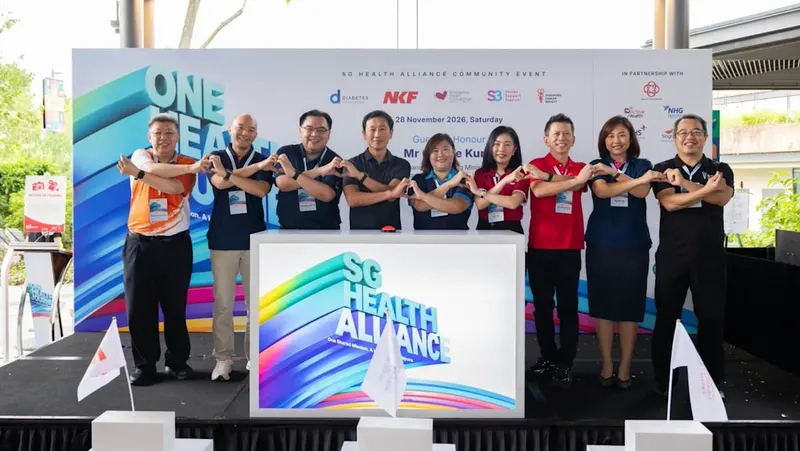
Table of Contents
Five Singapore community healthcare organisations launched the SG Health Alliance on Saturday, Nov 28, 2026, to coordinate prevention, screening and support for major chronic diseases.
The founding members are Diabetes Singapore, the National Kidney Foundation, the Singapore Cancer Society, the Singapore Heart Foundation and Stroke Support Station. Their shared proposition is direct: conditions with overlapping risks and patient needs should not be addressed through separate public education and referral systems, according to CNA.
A shared platform for five conditions
The alliance will run joint health education and community outreach covering diabetes, kidney disease, heart disease, stroke and cancer. It will encourage healthier habits, earlier detection and greater use of recommended screening, with particular attention on underserved and at-risk communities that face barriers to health information and care.
“At the heart of the alliance is a simple but important message: Five conditions, many connections, one shared opportunity for prevention,” the five organisations said in a joint statement.
The operating model extends beyond awareness campaigns. The organisations intend to help residents use existing screening and referral pathways, connect with family doctors and obtain rehabilitation, survivorship and peer support. They will also work with Singapore’s three regional healthcare clusters: NHG Health, the National University Health System and SingHealth.
Health Minister Ong Ye Kung, who is also coordinating minister for social policies, officiated at the launch in Bukit Canberra. The Straits Times reported that the alliance has support from the minister and the three clusters as it seeks to improve prevention and patient management.
Why early detection is a system priority
The burden behind the initiative is substantial. In 2025, cancer, ischaemic heart disease and cerebrovascular diseases, including stroke, together accounted for 53.4 per cent of all deaths in Singapore, according to figures cited by the alliance.
The National Population Health Survey 2024 also exposed a gap between eligibility and action. Less than half of eligible Singapore residents were screened for cancer, even though cancer was the leading cause of death.
For policymakers, the challenge is therefore not confined to clinical capacity. It also involves information, follow-through and the hand-offs between providers. A screening message has limited value if a resident cannot identify the next step, while a referral loses force if patients and families do not know what support exists beyond their immediate healthcare provider.
The five conditions also share underlying risks, including smoking, excess weight, unhealthy diets and physical inactivity. Maintaining a healthy weight, staying active and stopping smoking can reduce many of those risks. Joint outreach gives the organisations a way to repeat common advice without presenting each condition as an unrelated problem.
Mr Ong placed personal behaviour at the centre of that prevention effort.
“The mother of all diseases is your genetic makeup. The father of all diseases is your lifestyle,” he said.
“If you want to do something about controlling and managing those diseases, it goes back to your lifestyle: sleep, eat, exercise, friends, connections... all these matter a lot,” he added.
How cross-referrals could help patients
Singapore Heart Foundation chief executive Geoffrey Ong said the alliance hopes to facilitate cross-referrals among its partners, giving patients access to a broader set of healthcare resources.
“For instance, patients from our partner organisations who are identified to have heart conditions can be referred to SHF’s Heart Wellness Programme for rehabilitation support,” he said.
“Similarly, patients in our programme can be connected to other healthcare resources if they have additional chronic conditions,” he added.
That design reflects the reality of multimorbidity. A person with diabetes may also face higher risks of kidney disease, heart disease or stroke. Treating each interaction as a separate administrative track can leave families to assemble the care pathway themselves.
For 54-year-old Heelmy Abu Hassan, the cost of delayed action became clear after a haemorrhagic stroke caused by hypertension and a diagnosis of stage 3 chronic kidney disease. Lasting changes to his diet and lifestyle proved difficult. Kidney failure followed, and he started dialysis in 2022.
“I wish I had acted on my doctor’s advice earlier. When I found out I had kidney failure, I was shocked and in despair,” Mr Heelmy said.
“I was worried that I would become increasingly dependent on my family. Having kidney failure was a serious wake-up call for me,” he added. “Since then, I have become more mindful of what I eat, and I make sure I keep up with my doctor’s appointments and treatments.”
The delivery test for the alliance
The alliance’s effectiveness will depend on whether cooperation produces completed referrals, higher screening uptake and wider community reach. Its structure offers a useful division of labour: member organisations contribute specialist expertise and trusted networks, while the regional clusters provide connections into Singapore’s broader healthcare system.
Singapore Cancer Society chief executive Tan Kwang Cheak framed that task around the patient rather than the institution.
“People do not experience their health one disease at a time, so we should not support them that way,” he said.
The immediate agenda is practical. Members plan to improve awareness of one another’s services and identify appropriate referral routes so individuals can obtain more complete support. For residents, the clearest measure of progress will be a simpler route from risk information to screening, and from diagnosis to sustained care in the community.
SG Health Alliance: key questions
Which organisations belong to the SG Health Alliance?
Its members are Diabetes Singapore, the National Kidney Foundation, the Singapore Cancer Society, the Singapore Heart Foundation and Stroke Support Station.
What will the SG Health Alliance do?
It will coordinate health education, community outreach, screening encouragement and referrals across diabetes, kidney disease, heart disease, stroke and cancer.
Where was the alliance launched?
The launch took place at Bukit Canberra on Nov 28, 2026, with Health Minister Ong Ye Kung officiating.