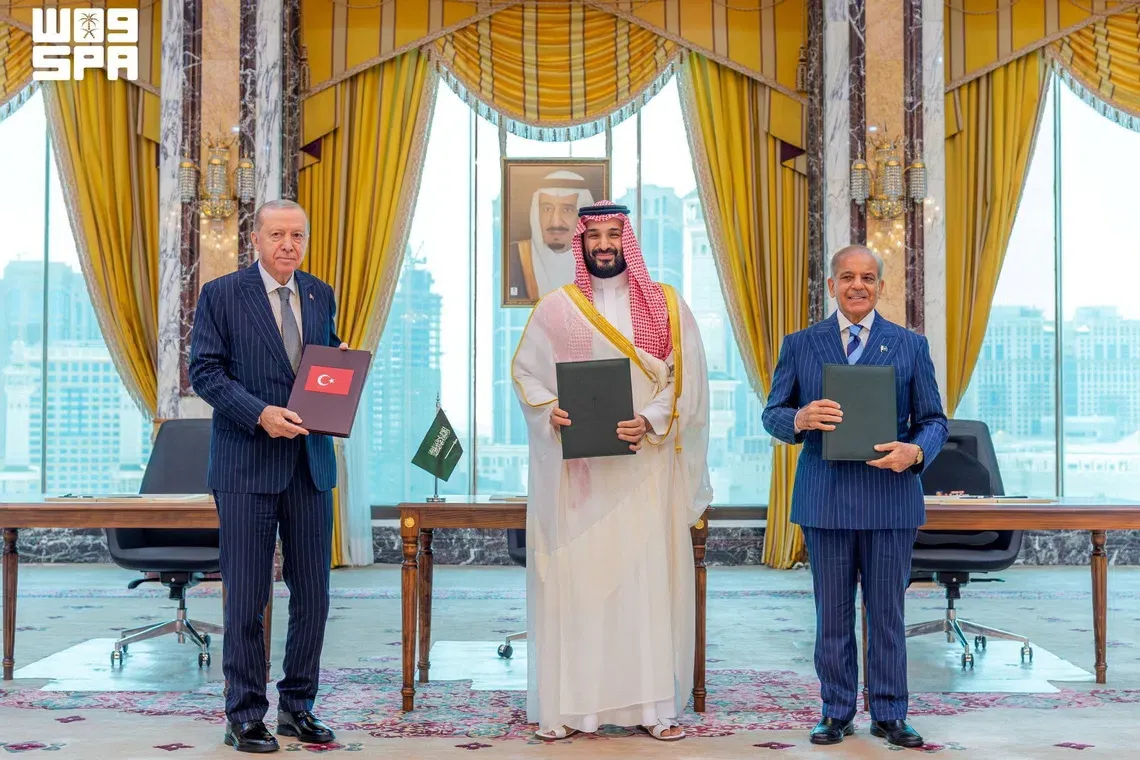
Bangladesh is considering joining the Mecca pact, a mutual defence agreement signed in August by Saudi Arabia, Turkey and Pakistan, according to a junior foreign minister. The move, if pursued, would mark a significant shift in Dhaka's long-standing policy of non-alignment, with potential ripple effects across South Asia and beyond.
Junior Foreign Minister Humayun Kabir told reporters on Aug 24 that Dhaka views the invitation positively. “If there is a security arrangement among Islamic nations in the Middle East, it is not unusual for us to consider participating. It is being viewed positively,” he said, adding that Saudi Arabia has invited Prime Minister Tarique Rahman to join.
A source in Bangladesh's foreign ministry, speaking on condition of anonymity, confirmed that Riyadh extended the invitation, though the timing was not disclosed.
What is the Mecca pact and why does it matter?
The Mecca pact, signed in the Saudi holy city in August, follows NATO's collective-defence principle: an armed attack on one member is treated as an attack on all. The signatories, all Sunni Muslim-majority nations, include Turkey (NATO's second-largest army), nuclear-armed Pakistan, and Saudi Arabia, a top oil exporter. Turkey has indicated the pact is open to expansion.
For Bangladesh, a secular republic with over 90 per cent Sunni Muslim population, joining would align Dhaka with a bloc perceived as counterbalancing Iran, especially amid heightened Middle East tensions.
How would the pact test Bangladesh's foreign policy?
Analysts argue that formal membership would test Bangladesh's core strategy of avoiding rival geopolitical camps, a stance that has helped it attract investment, expand exports, and maintain ties with competing powers. The economy relies heavily on readymade garment exports to the UK, EU, and US, and on remittances from workers in the Middle East.
Geopolitical analyst Kollol Kibria warns that joining a military bloc could complicate relations with India, China, Iran, Japan, Kuwait, Oman, Qatar, Russia, the UAE, and the US. “These relationships would not automatically break, but once Bangladesh joins a military bloc, the question of which side Bangladesh is on becomes much harder to avoid,” he said.
What are the implications for Bangladesh-India ties?
The invitation arrives at a delicate juncture. Ties with India are strained over accusations of border pushbacks and Dhaka's extradition request for former Prime Minister Sheikh Hasina, who has been in exile in India since August 2024. Prime Minister Rahman has yet to decide on a visit to India, pending New Delhi's response to the extradition request.
India's foreign ministry said it is closely following West Asia developments. Analysts suggest New Delhi would not welcome Bangladesh joining a pact that includes arch-foe Pakistan.
Asif Shahan, a development studies professor at Dhaka University, cautioned: “If Bangladesh joins this alliance, several countries, including India, will not be pleased. However, that should not be the basis of Bangladesh's decision.”
What are the economic risks and strategic trade-offs?
Formal alignment could create risks for Bangladesh's export-driven economy, which depends on stable commercial and diplomatic ties across a wide range of partners. The perception of taking sides may deter investment or complicate trade negotiations, even if existing relationships do not break outright.
For now, Dhaka appears to be weighing the benefits of Islamic solidarity and security guarantees against the potential costs to its balanced foreign policy. The decision, as analysts note, will ultimately hinge on broader economic and strategic consequences.
“If there is a security arrangement among Islamic nations in the Middle East, it is not unusual for us to consider participating.” — Humayun Kabir, junior foreign minister
FAQ: Bangladesh and the Mecca pact
What is the Mecca pact?
The Mecca pact is a mutual defence agreement signed in August by Saudi Arabia, Turkey, and Pakistan, modelled on NATO's collective-defence principle.
Why is Bangladesh considering joining?
Dhaka has received an invitation from Saudi Arabia, and junior Foreign Minister Humayun Kabir has said the proposal is being viewed positively, citing shared Islamic identity and regional security interests.
What are the main concerns?
Analysts highlight potential complications with India, China, and other partners, as well as risks to Bangladesh's export-driven economy and its policy of non-alignment.
What is the likely timeline?
No timeline has been announced. Prime Minister Tarique Rahman has yet to respond formally, and the decision is expected to involve careful diplomatic and economic assessment.